If you work with UV-curable coatings, inks, adhesives, or 3D printing resins, you’ve likely come across isobornyl acrylate (IBOA) and isobornyl methacrylate (IBOMA). They share the same bulky bicyclic isobornyl backbone, yet the single methyl group difference between them creates a surprisingly wide performance gap.
One gives you fast cure and low viscosity. The other delivers extreme hardness and long-term durability. Here’s how to choose.
Chemical name: Isobornyl acrylate
CAS No.: 5888-33-5
Molecular weight: 208 g/mol
Structure: Isobornyl group + acrylate double bond
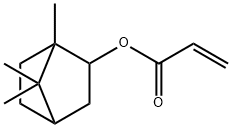
IBOA is a monofunctional acrylate monomer widely used as a reactive diluent in UV/EB curing systems. Its bicyclic structure provides an excellent balance of hardness, flexibility, and impact resistance.
Low viscosity (7–10 mPa·s at 25°C) – effectively reduces system viscosity without relying on solvents
High reactivity – acrylate double bond cures fast under UV/EB exposure
Low shrinkage – the bulky side group weakens interchain forces, resulting in significantly lower volume shrinkage compared to monomers like THFA and 2-PEA
High Tg (~94°C) – imparts hardness and thermal resistance to cured films
Good adhesion – particularly outstanding on metals, plastics (PET, PE, PP, PC), and glass
Bio-based – approximately 76% bio-renewable carbon content (derived from pine oil)
UV/EB coatings – reactive diluent for epoxy acrylate and urethane acrylate oligomers. Reduces viscosity and internal stress while maintaining film hardness. Suitable for automotive clearcoats, wood finishes, metal protection, and plastic coatings.
Printing inks – provides excellent scratch resistance, gloss retention, and chemical durability. Used in UV screen inks, inkjet inks, packaging inks, and outdoor signage.
3D printing resins (SLA/DLP) – low shrinkage ensures dimensional accuracy; high Tg provides part rigidity and heat resistance. Used in dental models, jewelry casting patterns, and engineering prototypes.
Adhesives – improves cohesive strength, peel resistance, and thermal stability in pressure-sensitive and structural adhesives. Used in optically clear adhesives (OCA), medical device bonding, and PSA tapes.
Specialty applications – dental restorative resins (low shrinkage reduces sensitivity), optical disc coatings, fiber optic coatings, and photoresists.
Chemical name: Isobornyl methacrylate
CAS No.: 7534-94-3
Molecular weight: 222 g/mol
Structure: Isobornyl group + methacrylate double bond (with an extra methyl group)
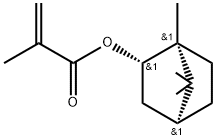
IBOMA is a monofunctional methacrylate monomer with an exceptionally high glass transition temperature. The extra methyl group on the double bond slows cure slightly but dramatically increases the hardness, durability, and weatherability of the final polymer.
Extremely high Tg (~170°C) – among the highest for any monofunctional monomer. This directly expands the continuous-use thermal window, making IBOMA the preferred hard-block monomer for applications requiring mechanical integrity above 120°C
High hardness and scratch resistance – the rigid isobornyl ring structure provides outstanding abrasion and wear resistance
Excellent weather and chemical resistance – hydrophobic nature makes it ideal for exterior applications where durability and moisture resistance are critical
Low shrinkage and low odor – minimizes cracking, warping, and poor adhesion; ideal for precision applications
Good adhesion – enhances gloss and adhesion to various substrates
Bio-based – approximately 71% bio-renewable carbon content (derived from pine resin)
Automotive coatings – provides scratch resistance, hardness, and gloss retention for automotive clearcoats and interiors.
Optical coatings and lenses – excellent optical clarity, UV stability, and chemical resistance make it indispensable for optical lenses, flexible displays, and fiber optic coatings.
Outdoor and industrial coatings – ideal for high-solid coatings, marine anti-fouling paints, and any system requiring long-term weatherability.
High-performance adhesives – low volatility and good bond durability for automotive and electronics assembly.
Powder coatings – improves gloss, chemical resistance, and weatherability.
The single extra methyl group on IBOMA’s double bond changes more than you might think.
Acrylate double bonds (IBOA) are inherently more reactive than methacrylate double bonds (IBOMA). The methyl group on IBOMA creates steric hindrance, slowing the polymerization rate. This means IBOA cures faster – a clear advantage for high-speed production lines. However, the trade-off is that methacrylate polymers generally offer better long-term durability, weatherability, and hardness.
A 76°C difference in Tg is enormous for a monofunctional monomer. IBOA’s ~94°C Tg already places it among the harder monofunctional acrylates. IBOMA’s ~170°C Tg, by contrast, is closer to what you’d expect from a highly crosslinked multifunctional monomer. This gives IBOMA a unique position: it delivers hardness and thermal stability typically associated with multifunctional monomers, but with the low viscosity and handling benefits of a monofunctional monomer.
Both monomers offer low shrinkage, but for slightly different reasons. IBOA’s bulky side group weakens interchain forces, reducing relative stress and volume shrinkage. Studies have shown that volumetric shrinkage and shrinkage stress decrease with increasing IBOA concentration in composite resin formulations. IBOMA similarly offers low curing shrinkage, making both suitable for high-precision applications like 3D printing and optical coatings.
Both monomers are derived from pine oil (turpentine), making them partially bio-based alternatives to petroleum-derived acrylates. IBOA contains approximately 76% bio-renewable carbon, while IBOMA contains approximately 71%. For formulators working toward sustainability goals, both monomers offer a meaningful reduction in fossil-based content.
You need to reduce formulation viscosity efficiently
You want fast UV cure for high‑throughput production
You’re applying thin coatings on flexible plastic substrates (PET, PE, PP)
You need low shrinkage to prevent warping and delamination
You’re formulating general‑purpose coatings, inks, or adhesives where cost and processability matter most
You need exceptional hardness and scratch resistance
Your coating will be exposed to outdoor weather, UV, or chemicals long‑term
You’re formulating automotive clearcoats, optical coatings, or high‑durability industrial finishes
You need thermal stability above 120°C where PMMA or PS‑based systems would fail
Gloss retention and clarity are critical
Many formulations use both: IBOA for viscosity reduction and fast cure, IBOMA for hardness and durability. The optimal ratio depends on your specific requirements – IBOA to control rheology and cure speed, IBOMA to push hardness and weather resistance.
As reactive diluent: IBOA is typically used at 10–40% of total formulation. IBOMA at similar levels, but expect slightly slower cure – adjust photoinitiator package if necessary.
Compatibility: Both monomers show good compatibility with epoxy acrylates, urethane acrylates, polyester acrylates, and common oligomers.
Adhesion: IBOA provides particularly strong adhesion to polyolefins and metals. IBOMA enhances gloss and adhesion across a broad range of substrates.
Bio‑based formulation: Both monomers can help you achieve higher bio‑renewable content in your formulations – IBOA at ~76%, IBOMA at ~71%.
Q: Can IBOMA replace IBOA directly?
Not at a 1:1 ratio. IBOMA has higher viscosity and slower cure speed. You’ll need to adjust the photoinitiator package and re‑evaluate rheology. The final film will be harder and more durable, but the processing window will shift.
Q: Which one is more bio‑based?
IBOA has a higher bio‑based carbon content (~76%) than IBOMA (~71%). Both are derived from pine oil (turpentine), a renewable resource.
Q: Which one is better for 3D printing?
IBOA is more commonly used in 3D printing resins because of its lower viscosity, faster cure, and low shrinkage. IBOMA can be used when higher green strength or thermal resistance is needed, but the higher viscosity may require adjustment of the resin formulation.
Q: Is the lower cure speed of IBOMA a disadvantage?
It depends on your application. For high‑speed production lines, yes – IBOA is faster. For applications requiring maximum durability, weatherability, and hardness, the slightly slower cure of IBOMA is an acceptable trade‑off for the performance gains.
Q: Are these monomers compatible with each other?
Yes. IBOA and IBOMA are fully compatible and can be blended in any ratio. Many formulators use blends to fine‑tune the balance between cure speed, viscosity, hardness, and durability.
Q: What about skin irritation?
Both are acrylate/methacrylate monomers and may cause skin irritation in their liquid form. Standard handling precautions (gloves, protective clothing, adequate ventilation) should always be followed.
Q: Can I use these in LED curing systems?
Yes, both monomers are suitable for LED and mercury lamp UV curing systems. The photoinitiator package should be selected based on your specific light source wavelength.
This article is for informational purposes. Always validate performance in your own formulation through laboratory trials.