In UV/EB curing systems, monofunctional acrylate monomers are the building blocks that determine viscosity, adhesion, flexibility, and cure response. Among them, aromatic (benzene‑ring) monomers form a distinct family defined by their conjugated ring structures – including phenyl, biphenyl, and benzyl groups.
These monomers deliver high refractive index, high gloss, strong adhesion, and excellent dilution power, making them indispensable for indoor coatings, printing inks, optical films, and general‑purpose UV adhesives.
However, they come with trade‑offs: poor weatherability, yellowing tendency, higher skin irritation, and limited compatibility with non‑polar polyolefins (PP, PE). Understanding these strengths and limitations is key to selecting the right monomer for your formulation.
This guide covers six key aromatic monomers: SINOMER® OPPEA, SINOMER® PHEA, SINOMER® BZA, SINOMER® BZMA, SINOMER® PBA, and SINOMER® NP-4EA, with performance data, application guidance, and selection criteria.
Across the family, benzene‑ring monomers share these advantages:
| Attribute | Benefit |
|---|---|
| High refractive index | Increases gloss, depth, and color richness – essential for high‑gloss inks and overprint varnishes |
| Strong adhesion | Excellent wetting and anchoring on ABS, PC, PVC, PS, metals, glass, and epoxy surfaces |
| Excellent dilution power | Lowers viscosity of high‑molecular‑weight oligomers – suitable for inkjet, screen, and gravure printing |
| Good leveling | Reduces orange peel and cratering for smooth, defect‑free films |
| High rigidity & solvent resistance | Dense crosslinked films resist alcohol, solvents, and abrasion – superior to flexible heterocyclic monomers |
| Limitation | Impact |
|---|---|
| Poor weatherability | Benzene rings absorb UV light – severe yellowing under outdoor exposure. Not suitable for exterior applications |
| Higher skin irritation | Most contain MEHQ; irritancy is higher than alicyclic or heterocyclic monomers. Exercise caution in medical or food‑contact formulations |
| Brittleness | High loading can cause cracking, whitening on bending, or warping on thin films – blend with flexible monomers to compensate |
| Poor adhesion to polyolefins | Weak wetting on PP, PE, and fluoroplastics – far inferior to ACMO, TBCHA, or THFA |
Biphenyl‑based premium monomer with the highest refractive index among commercial monofunctional acrylates.
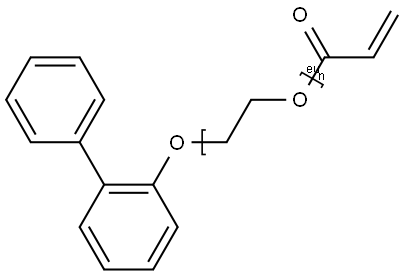
| Parameter | Value |
|---|---|
| Refractive Index | ~1.575 |
| Tg | ~32°C |
| Viscosity | 100 – 200 cps |
| Curing Shrinkage | < 5% |
Key Advantages:
Highest refractive index in its class – essential for AR/VR optics, OCA optical adhesives, and light‑guide coatings
Balances hardness and toughness – low internal stress, minimal warping on thin films
Low odor and low skin irritation – suitable for food‑contact and UV nail gel applications
Good water, chemical, and heat resistance – outperforms single‑ring monomers
Limitations:
Higher viscosity than PHEA or BA
Higher cost – premium positioning
Still susceptible to gradual yellowing under prolonged outdoor exposure
Pure film tends to soften at elevated temperatures (tackiness)
Primary Applications:
Optical films, AR/VR devices, high‑precision SLA 3D printing, photoresists, flexible electronic encapsulation, specialty adhesives.
The industry standard – most widely used aromatic monofunctional monomer for general‑purpose UV systems.
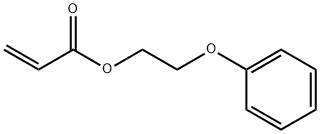
| Parameter | Value |
|---|---|
| Refractive Index | ~1.516 |
| Tg | ~6°C |
| Viscosity | 5 – 15 cps |
| Curing Shrinkage | ~8% |
Key Advantages:
Best overall balance of adhesion, leveling, dilution, and hardness
Low viscosity – excellent processing characteristics
Highly cost‑effective – the go‑to “workhorse” monomer
Limitations:
Moderate weatherability – not suitable for long‑term outdoor use
Noticeable odor and skin irritation
Low Tg – limited heat resistance; prone to tackiness above 50°C
Primary Applications:
Indoor plastic coatings, wood coatings, screen/gravure UV inks, and general‑purpose UV adhesives.
The lowest‑viscosity aromatic monomer – extreme dilution power and strong wetting.

| Parameter | Value |
|---|---|
| Refractive Index | ~1.514 |
| Tg | ~3°C |
| Viscosity | 2 – 5 cps |
| Curing Shrinkage | ~9% |
Key Advantages:
Extremely low viscosity – excellent reactive diluent
Superb wetting – improves substrate penetration
Enhances optical clarity of cured films
Limitations:
Higher volatility and stronger odor
More brittle film compared to other aromatic monomers
Poorer yellowing resistance
Primary Applications:
UV inkjet inks, high‑solid gloss coatings, and auxiliary viscosity‑reduction monomer.
The methacrylate analogue of BZA – higher Tg, better heat resistance.
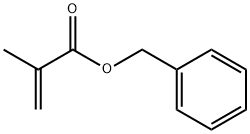
| Parameter | Value |
|---|---|
| Refractive Index | ~1.513 |
| Tg | ~54°C |
| Viscosity | 8 – 15 cps |
Key Advantages:
Higher Tg than BZA – improves heat and block resistance
Better scratch resistance and hardness
Slightly lower odor and volatility than acrylate version
Primary Applications:
Heat‑resistant plastic coatings, appliance UV coatings, and high‑temperature electronic inks.
Biphenyl‑based specialty monomer for high‑end optical and chemically resistant systems.
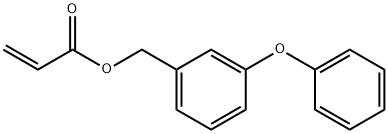
| Parameter | Value |
|---|---|
| Refractive Index | ~1.570 |
| Tg | ~33°C |
| Viscosity | 40 – 80 cps |
Key Advantages:
High refractive index – optical‑grade clarity
Strong chemical resistance – suitable for aggressive solvent environments
Low shrinkage and good toughness – better than BZA
Primary Applications:
Premium optical inks, transparent UV adhesives, lens coatings, and high‑end encapsulation.
Extreme wetting monomer for difficult substrates – domestic use only.
| Parameter | Value |
|---|---|
| Refractive Index | ~1.498 |
| Tg | ~ –12°C |
| Viscosity | 30 – 60 cps |
Key Advantages:
Excellent wetting on difficult plastics and leather surfaces
Strong adhesion to low‑energy substrates
Cost‑effective for industrial applications
Critical Limitation:
Contains nonylphenol ethoxylates – subject to EU REACH restrictions (Annex XVII). Prohibited for export to the EU. Only suitable for domestic industrial formulations in markets without NP regulations.
Primary Applications (Domestic Only):
Leather UV coatings, low‑end plastic inks, industrial wood coatings.
| Scenario | Recommended Monomers |
|---|---|
| High‑gloss coatings & inks | OPPEA, PHEA, BZA |
| Adhesion to polar plastics (ABS, PC, PVC) | PHEA, OPPEA, PBA |
| Low‑viscosity inkjet formulations | BZA |
| Heat‑resistant coatings | BZMA |
| Optical/AR/VR applications | OPPEA, PBA |
| Cost‑effective general‑purpose UV systems | PHEA |
| Food‑contact or low‑irritation formulations | OPPEA |
| Scenario | Why | Alternative |
|---|---|---|
| Outdoor / UV‑exposed applications | Severe yellowing | Alicyclic or heterocyclic monomers (CHA, THFA, ACMO) |
| Adhesion to PP / PE | Poor wetting | ACMO, TBCHA, THFA |
| Flexibility / low‑shrinkage | Brittle films | Flexible heterocyclic monomers |
| EU REACH compliance | NP series contains restricted substances | PHEA, OPPEA, or non‑NP alternatives |
| Medical / food‑contact with MEHQ restrictions | Skin irritation and regulatory concerns | MEHQ‑free alicyclic or heterocyclic monomers |
| Product | Key Feature | Best‑For Applications |
|---|---|---|
| SINOMER® OPPEA | Highest RI (1.575), low irritation | Optical coatings, AR/VR, 3D printing, photoresists |
| SINOMER® PHEA | Best cost‑performance balance | General indoor coatings, inks, adhesives |
| SINOMER® BZA | Lowest viscosity, extreme dilution | UV inkjet, high‑solid gloss coatings |
| SINOMER® BZMA | Highest Tg, heat resistance | Heat‑resistant plastic coatings, appliance coatings |
| SINOMER® PBA | High RI, chemical resistance | Premium optical inks, lens coatings, transparent adhesives |
| SINOMER® NP-4EA | Extreme wetting (NP‑based) | Domestic leather and industrial coatings only – not for EU |
Q: What is the main difference between aromatic and alicyclic monomers?
A: Aromatic monomers (benzene‑ring) offer higher refractive index, gloss, and adhesion but yellow under UV exposure. Alicyclic monomers offer superior weatherability, lower yellowing, and better adhesion to polyolefins.
Q: Which aromatic monomer has the highest refractive index?
A: SINOMER® OPPEA has the highest refractive index (~1.575) among commercial monofunctional acrylates.
Q: Can I use aromatic monomers for outdoor coatings?
A: Generally no. They yellow rapidly under UV exposure. For outdoor applications, use alicyclic or heterocyclic monomers.
Q: Is SINOMER® BZA suitable for inkjet inks?
A: Yes. Its extremely low viscosity and excellent dilution power make it ideal for low‑viscosity UV inkjet formulations.
Q: Can I replace PHEA with BZA to reduce viscosity?
A: Yes, but be aware BZA gives more brittle films and higher odor. Test adhesion and flexibility before full replacement.
Q: What is the difference between BZA and BZMA?
A: BZMA is the methacrylate version – it offers higher Tg (54°C vs 3°C), better heat resistance, and slightly lower volatility.
Q: Is NP-4EA suitable for EU export?
A: No. NP‑4EA contains nonylphenol ethoxylates, which are restricted under REACH. Use PHEA or OPPEA for EU‑bound formulations.
Q: Can I use OPPEA for food‑contact applications?
A: OPPEA offers lower odor and skin irritation, but food‑contact approval depends on final formulation and regulatory compliance. Please contact our technical team for specific guidance.
Q: How do I formulate flexible yet glossy coatings?
A: Blend aromatic monomers (for gloss) with flexible heterocyclic or aliphatic monomers to balance hardness and flexibility.
Sinocure Chemical Group
No. 61, South Industrial Road, Jinan Area of Shandong Pilot Free Trade Zone, China
Email: Info@sinocurechem.com | Tel: +86 15668330235
Website: www.sinocurechem.com
For samples, technical data sheets, or custom formulation support, please contact our technical team.
This document is for informational purposes only. Users should conduct their own testing to determine suitability for their specific applications. SINOMER® is a registered trademark of Sinocure Chemical Group.