In the world of specialty chemicals, some products stay quietly behind the scenes while powering dozens of industries. Sinomer® DMAA (N,N‑Dimethylacrylamide, NNDMA) is exactly that kind of workhorse. It looks like a clear liquid, but its performance profile is anything but ordinary.
If you’ve ever worn soft contact lenses, held a pressure‑sensitive label, or used a UV‑curable ink, you’ve already met DMAA. Let’s take a closer look at why this monomer is so widely adopted – and how Sinomer® DMAA can upgrade your formulation.
Sinomer® DMAA is the commercial grade of N,N‑dimethylacrylamide (CAS 2680‑03‑7). It is a monofunctional amide monomer that combines a reactive double bond with a polar dimethylamide group.
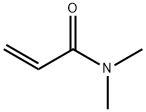
Molecular formula: C₅H₉NO
Appearance: Colorless to pale yellow transparent liquid
Key physical properties:
| Property | Typical Value |
|---|---|
| Purity | ≥ 99.0% |
| Flash point | 70 °C |
| Boiling point (20 mmHg) | 81 – 84 °C |
| Refractive index | 1.4729 – 1.4732 |
| Density (g/ml) | 0.962 – 0.966 |
| Inhibitor (MEHQ, ppm) | 450 – 550 |
| Water content | ≤ 0.3% |
| Color (APHA) | ≤ 50 |
Data based on standard specifications; COA available upon request.
The molecule contains a vinyl group that readily undergoes free‑radical polymerization, plus a hydrophilic amide side chain. This dual nature makes DMAA extremely versatile: it copolymerizes with acrylates, methacrylates, styrene, vinyl acetate, and many other monomers, while imparting hydrophilicity, adhesion, and low shrinkage.
Sinomer® DMAA has very low viscosity (roughly 2–4 mPa·s at 25°C), making it an excellent reactive diluent for UV/EB curing systems. It lowers formulation viscosity without relying on non‑reactive solvents, helping you maintain high solids and fast cure.
Unlike many acrylate monomers, DMAA polymerizes with remarkably low volumetric shrinkage. This property is critical for precision applications such as 3D printing, optical coatings, and dental materials. At the same time, the amide group creates strong interactions with polar substrates – glass, metals, PET, PC, and even untreated polyolefins after proper formulation.
DMAA is miscible with water and highly hygroscopic. This makes it a key component in anti‑fog coatings, hydrogel contact lenses, and moisture‑management textiles.
The vinyl group in DMAA polymerizes readily under UV, thermal, or redox initiation. It works well with both conventional photoinitiators (e.g., 1173, TPO) and co‑initiators, providing fast cure speeds even in thin films.
DMAA is a cornerstone monomer for soft contact lenses. Its copolymers form clear, oxygen‑permeable hydrogels that remain comfortable on the eye. Beyond lenses, it is used in wound dressings, transdermal patches, and other biomedical gels where low irritation and good water retention are required.
In harsh downhole environments (high temperature, high salt), ordinary polymers break down. DMAA‑based copolymers act as viscosifiers, fluid loss controllers, and oil displacement agents. They improve cement slurry stability and enhance enhanced oil recovery (EOR) efficiency.
Because of its low viscosity, low shrinkage, and strong adhesion, Sinomer® DMAA is widely used in:
UV inkjet inks – fast jetting, excellent wetting on plastic films
Screen printing inks – improved flow and image sharpness
UV adhesives – bond strength on difficult substrates (glass, PC, PET)
3D printing resins – low warpage, good detail resolution
DMAA can be grafted onto acrylic, nylon, or polyester fibers to improve moisture absorption, anti‑static properties, and dye uptake. End products feel softer and resist static buildup in dry weather.
DMAA polymers serve as dry strength agents in papermaking and as gelatin substitutes in photographic layers. They also function as dye dispersants and pressure‑sensitive adhesive components in color printing paper.
Any system that benefits from increased polarity, better adhesion, or reduced shrinkage can be upgraded with DMAA. It is compatible with most acrylates, methacrylates, and styrenic resins.
Recommended dosage (as reactive diluent or functional monomer):
Typically 5–30% of total formulation weight, depending on target viscosity and properties.
Incorporation:
Sinomer® DMAA mixes easily with most oligomers and monomers. It can be added at any stage of the mixing process, but best results are obtained when added before the pigment dispersion step.
Storage:
Store in a cool, dry, well‑ventilated area away from light and heat. Keep containers tightly sealed due to its hygroscopic nature. Shelf life: 12 months under recommended conditions.
What makes Sinomer® DMAA special is not just its chemistry – it’s the consistency, purity, and technical support behind it. Whether you need an industrial grade for oilfield applications or a high‑purity, low‑odor monomer for UV coatings and medical devices, we provide reliable supply and full traceability.
Do you have a specific application in mind?Click here: "Contact Us"
Contact us for samples, TDS, and formulation guidance. We’ll help you unlock the full potential of DMAA in your system.